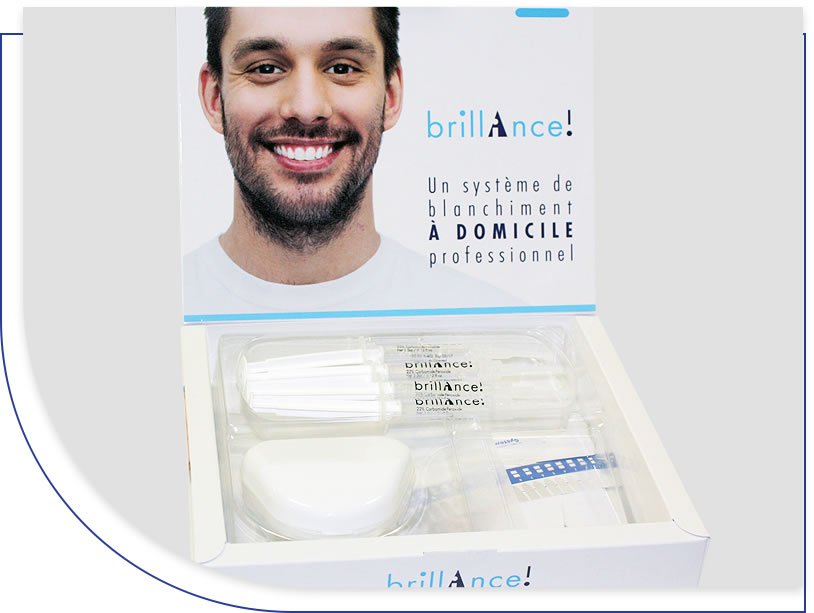
>Professional Take-Home Whitening System

Brilliance is easy to use

Like other whitening systems, Brilliance is also a carbamide peroxide gel that is applied to the teeth through the use of a custom bleaching tray. The Brilliance technique has been shown to result in an unsurpassed combination of long-lasting results and low sensitivity. The highly thixotropic Brilliance gel is dispensed from syringes and is suitable for day or night wear.


Brilliance clinical cases

Shade registration before treatment


Whitened teeth compared against original shade


Treatment in progress, upper arch completed.


Treatment in progress, upper arch completed.


More than a whitening system, it's a practice builder

You will appreciate the consistent and reliable results you will get with the Brilliance whitening system. It is the result of a 2-year clinical study undertaken at the University of Montreal to determine which concentrations and techniques could be effective, easy and safe to use.

Brilliance can really be a practice builder because of its very low price. Considering that the average charge for a complete whitening treatment done at home by the patient ranges between $300.00 and $590.00 for both arches, the financial rewards for your clinic can be formidable.


Brilliance FAQ:

Q. When is a Brilliance treatment contra-indicated?

A. Patients with oral lesions should not commence a Brilliance treatment. Patients should be caries-free and have healthy gums. Brilliance is an esthetic treatment and should only be undertaken when oral health is well controlled. Most situations in which bleaching is not advisable can be overcome.

The presence of crowns on certain teeth can be considered a contra-indication. However, the patient can be advised that these crowns will not whiten and must be redone after the Brilliance treatment. Composite restorations present a similar situation.

A sufficient amount of motivation is required to undertake a treatment that will require between six and eight weeks for lasting results. Non co-operative patients or those who don’t have a strong desire for whiter teeth can be difficult cases. The example that comes to mind is someone who agreed to whiten his/her teeth to please a spouse.


Q. Should smokers take special precautions while whitening their teeth?

A. Tooth whitening and smoking are in opposition to one another - smoking is a major cause of tooth discoloration. It is our opinion that one should not smoke for the duration of the treatment and one should not smoke at all.


Q. Can a Brilliance treatment be undertaken during pregnancy?

A. There are no studies relating bleaching and pregnancy. It would be prudent to postpone treatment until pregnancy is brought to term since the peroxide could cross over into the placenta.


Q. What can be done to prevent soft tissue irritation?

A. Sensitivity is a signal that something is wrong. The Brilliance tray can be adjusted at control appointments to ensure that it does not irritate gingival tissues.


Q. If patients experience tooth hypersensitivity, how can it be reduced?

A. We recommend the use of stannous fluoride whenever patients experience tooth sensitivity. Stannous fluoride can be applied at the end of each Brilliance session. Patients can apply a pea size quantity of stannous fluoride gel to a toothbrush and brush as with regular toothpaste.


Q. What is the duration of a Brilliance treatment and what factors affect the duration?

A. Brilliance treatment generally begins with the upper arch, as these teeth are more evident. In most cases, a satisfactory result is obtained after three or four weeks. In certain cases, we have observed better results by extending the treatment up to six weeks on the upper arch. An important improvement is often noted in the first week of treatment.

The lower arch generally whitens at a faster rate (two to four weeks) since the teeth are thinner and smaller. Also, since the soft tissue has already been exposed to the gel, treatment can commence with longer bleaching sessions. Also, gravity assists in drawing the gel to the gingival third of the teeth on the lower arch.

Treatment duration depends largely on the degree and nature of discoloration as well as patient age. Younger patients generally whiten more quickly. Yellow-brown staining generally whitens easily, while grey-blue staining is more difficult. Another factor is the patient’s capacity and willingness to wear the Brilliance tray.


Q. Why is it preferable to bleach only one arch at a time?

A. Wearing two Brilliance trays simultaneously increases interference with occlusion. This interference can also destabilize the Brilliance trays, reducing their effectiveness and resulting in soft tissue irritation.

Bleaching both arches together results in the loss of a reference point, which is an important source of motivation for patients.


Q. How long does it take to see results?

A. For many patients, a color shift can be noticed after the very first Brilliance session. For most patients, an appreciable change has taken place by the end of the first week.


Q. Why does Brilliance use an 11% carbamide peroxide concentration as opposed to 16% carbamide peroxide?

A. A clinical comparison of both concentrations has shown that a 16% concentration will whiten teeth more quickly during the first few days of treatment, however, by the end of a two week treatment, results are similar with either 11% or 16% carbamide peroxide. The side effects of an 11% gel are however much less than with a 16% concentration.


Q. Are there any advantages to using a higher gel concentration?

A. We don’t see the use for these concentrations since patients at a higher risk of experiencing side effects (gingival irritation, hypersensitivity, etc.) while obtaining the same results.


Products that make sense!